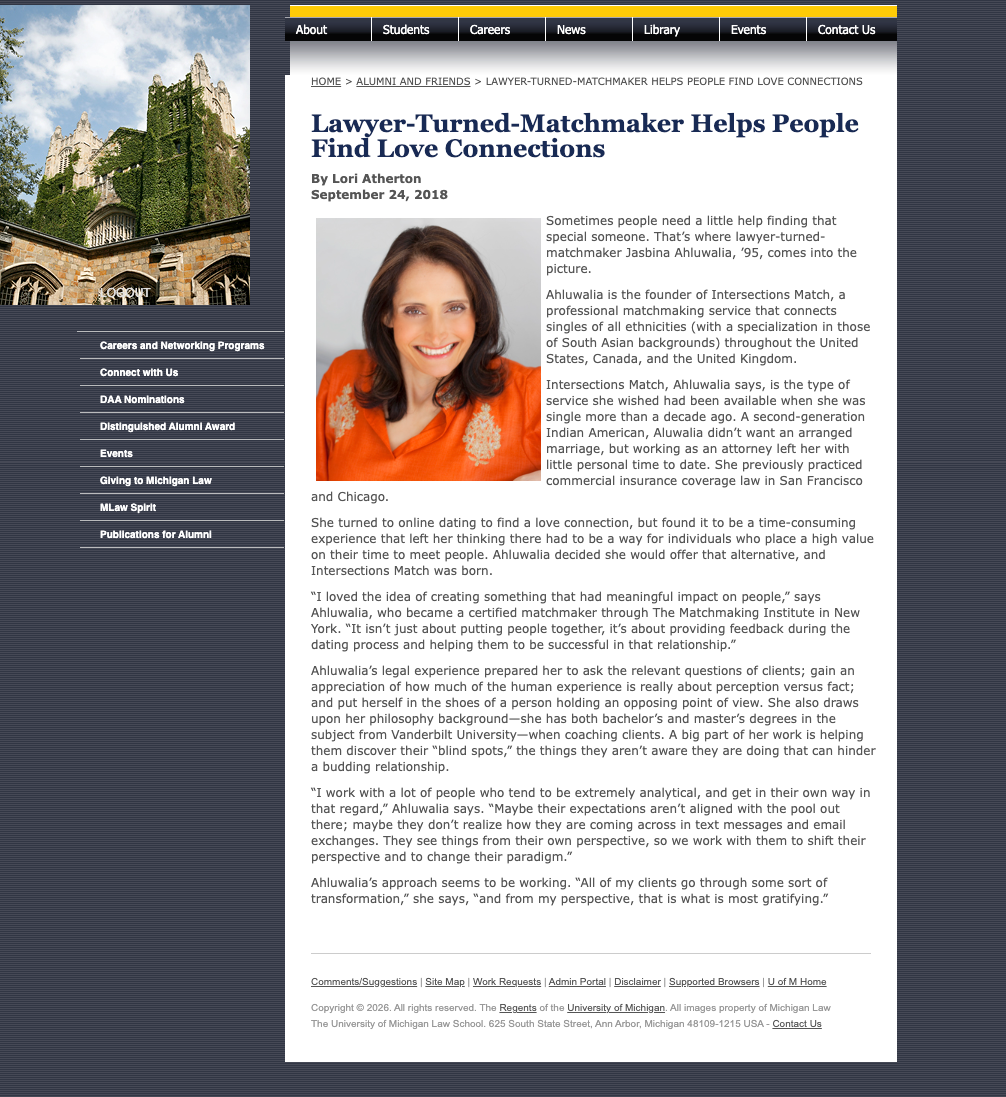
Sometimes people need a little help finding that special someone. That’s where lawyer-turned-matchmaker Jasbina Ahluwalia, ’95, comes into the picture.
Ahluwalia is the founder of Intersections Match, a professional matchmaking service that connects singles of all ethnicities (with a specialization in those of South Asian backgrounds) throughout the United States, Canada, and the United Kingdom.
Intersections Match, Ahluwalia says, is the type of service she wished had been available when she was single more than a decade ago. A second-generation Indian American, Aluwalia didn’t want an arranged marriage, but working as an attorney left her with little personal time to date. She previously practiced commercial insurance coverage law in San Francisco and Chicago.
She turned to online dating to find a love connection, but found it to be a time-consuming experience that left her thinking there had to be a way for individuals who place a high value on their time to meet people. Ahluwalia decided she would offer that alternative, and Intersections Match was born.
“I loved the idea of creating something that had meaningful impact on people,” says Ahluwalia, who became a certified matchmaker through The Matchmaking Institute in New York. “It isn’t just about putting people together, it’s about providing feedback during the dating process and helping them to be successful in that relationship.”
Ahluwalia’s legal experience prepared her to ask the relevant questions of clients; gain an appreciation of how much of the human experience is really about perception versus fact; and put herself in the shoes of a person holding an opposing point of view. She also draws upon her philosophy background—she has both bachelor’s and master’s degrees in the subject from Vanderbilt University—when coaching clients. A big part of her work is helping them discover their “blind spots,” the things they aren’t aware they are doing that can hinder a budding relationship.
“I work with a lot of people who tend to be extremely analytical, and get in their own way in that regard,” Ahluwalia says. “Maybe their expectations aren’t aligned with the pool out there; maybe they don’t realize how they are coming across in text messages and email exchanges. They see things from their own perspective, so we work with them to shift their perspective and to change their paradigm.”
Ahluwalia’s approach seems to be working. “All of my clients go through some sort of transformation,” she says, “and from my perspective, that is what is most gratifying.”